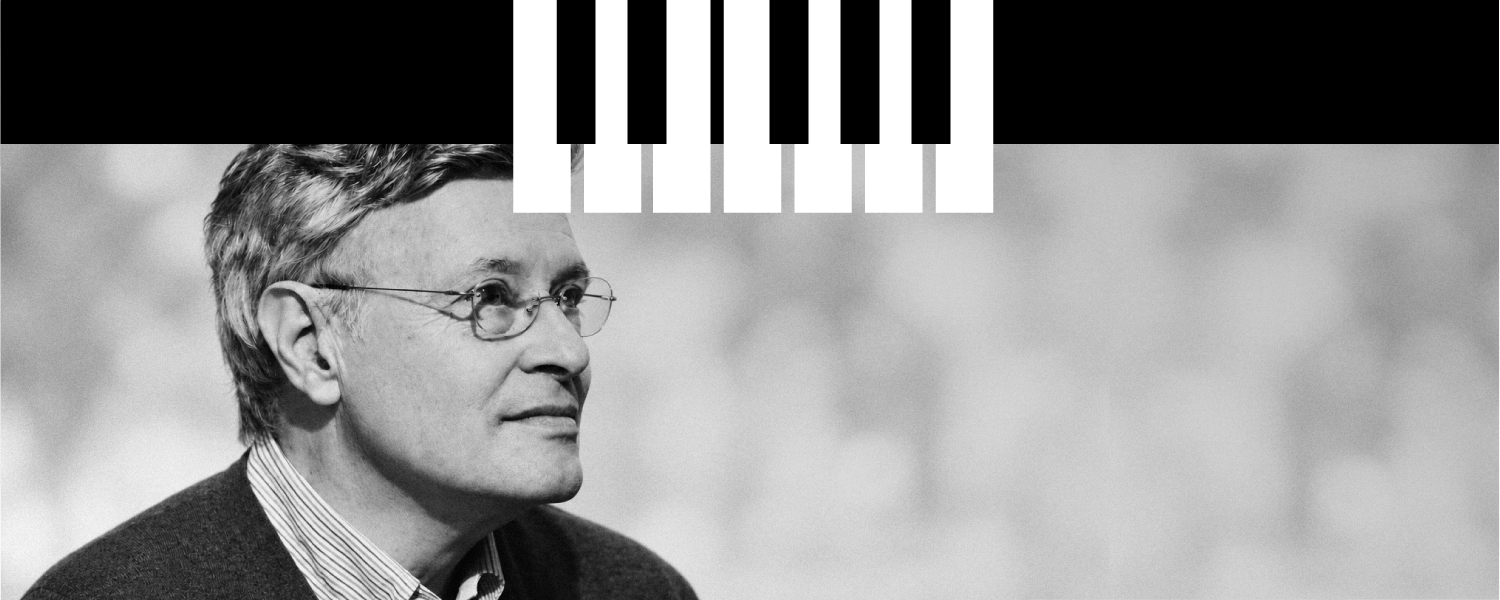
Live musicHomero Francesch. Piano Recital
His presence at the Auditorio Nacional Adela Reta constitutes an event of special artistic significance. His exceptional career, his connection with a central repertoire in music history, and the recognition he has achieved over decades make him one of the most internationally prominent Uruguayan figures in classical music. His return to Sodre represents, moreover, the opportunity to welcome again to the Auditorio Nacional Adela Reta an interpreter whose trajectory has brought Uruguayan music to some of the most important halls and stages in the world. This encounter with the Uruguayan public acquires special meaning due to the dimension of his artistic trajectory and the connection that Francesch maintains with a repertoire that has accompanied much of his career. Born in Montevideo, Homero Francesch began his piano studies with Santiago Baranda Reyes. At 19 years old he obtained a scholarship from the German Academic Exchange Service (DAAD) to continue his studies in Germany, where he studied in Munich with Hugo Steurer and later with Ludwig Hoffmann. From then on he developed an extensive international career, with performances in Europe, the United States, Canada, Japan, Australia, and Latin America. As a soloist he performed with orchestras such as the Berlin Philharmonic, Vienna Philharmonic, Royal Concertgebouw Orchestra, London Symphony Orchestra, New York Philharmonic, and Cleveland Orchestra, and worked under the direction of figures such as Leonard Bernstein, Kurt Masur, Colin Davis, Herbert Blomstedt, Riccardo Chailly, and Hans Werner Henze, among others. His discography, published by labels such as Deutsche Grammophon, Kontrapunkt, and Tudor Recording AG, encompasses a broad repertoire. In February 2026, Deutsche Grammophon again published digitally, within its Debut Series, his historic recording of works by Schumann, Mendelssohn, and Ravel. Francesch has participated in some of the major international festivals and also developed important pedagogical work and artistic direction. He was a professor at the University of the Arts in Zurich and artistic director of the Sommer Akademie Lenk in Switzerland and the Viersener Musiksommer. Among the distinctions received throughout his career are the Deutscher Schallplattenpreis and the Gold Medal of the Duszniki Chopin Festival. In Uruguay, he was declared an Illustrious Citizen of Montevideo in 2021 and also received the Premio Oribe, 9th edition, in the Music category, and the Premios Ala in 2023. Program His return to the Sala Eduardo Fabini proposes a journey through more than two centuries of piano writing, from Mozart and Beethoven to Hans Werner Henze, with Robert Schumann's Symphonic Etudes as the culmination. More than a chronological succession of works, the program allows observing different ways of thinking about the piano: the clarity and concentration of Mozartian classicism, the dramatic expansion of Beethoven, the reinvention of tradition in Henze, and the almost orchestral imagination that Schumann brings to the instrument. The Sonata in B-flat major, KV 570, written by Mozart in 1789, is a work of great formal clarity and economy of means, in which expressivity emerges from especially concentrated and refined writing. Beethoven builds on that classical heritage in the Sonata in D major, op. 10 no. 3, but takes the form toward territory of greater breadth and dramatic contrast, especially in the intense Largo e mesto. At the center of the recital appears Cherubino, by Hans Werner Henze, a piece that introduces not only another era but also an autobiographical dimension for the interpreter. Francesch gave the world premiere of these three miniatures in Berlin in 1981. Forty-five years later, performing them again within the framework of Henze's centenary has special significance: Francesch returns to a work whose history he has known since the moment of its premiere. Schumann's Symphonic Etudes, Op. 13, finally lead the program toward piano writing of great breadth. In them variation, the piano etude, and an imagination of almost orchestral character intersect, based on a theme that transforms again and again throughout the work. In its first 1837 edition, the theme gave rise to twelve etudes; later the supplementary variations that today form part of the interpretive tradition of the cycle were also incorporated. The program also touches central areas of Francesch's own trajectory. His discography includes extensive work on Mozart—Kontrapunkt published his piano sonatas and concertos—and recordings of Schumann for Deutsche Grammophon, along with sustained presence of Henze's music. Wolfgang Amadeus Mozart (Salzburg, 1756 – Vienna, 1791) Sonata in B-flat major, KV 570 Allegro Adagio Allegretto Ludwig van Beethoven (Bonn, 1770 – Vienna, 1827) Sonata in D major, op. 10 no. 3 Presto Largo e mesto Menuetto. Allegro Rondo. Allegro Hans Werner Henze (Gütersloh, 1926 – Dresden, 2012) On the centenary of his birth (1 July 1926) Cherubino. Three miniatures for piano Andante cantabile Sostenuto Con allegrezza World premiered by Homero Francesch on the occasion of the opening of the 1981/82 season of the Deutsche Oper Berlin. Robert Schumann (Zwickau, 1810 – Endenich, near Bonn, 1856) Symphonic Etudes, Op. 13 (1837 version), with five posthumous variations Theme. Andante Etude I. Un poco più vivo Etude II. Marcato il canto Etude III. Vivace Etude IV Etude V Five posthumous variations Andante. Tempo del tema Meno mosso Allegro Allegretto Moderato Etude VI. Agitato Etude VII. Allegro molto Etude VIII. Andante Etude IX. Presto possibile Etude X. Allegro Etude XI. Andante con espressione Etude XII. Finale. Allegro brillante
Paid eventLive music